Sunday, October 28, 2012

Trick or Treat: Worms?!

This week will be the first week we really dive into nonfiction in our classroom. I LOVE teaching with nonfiction because it is always so high interest. Our pacing guide has us covering topic, main idea and details. This year, under the leadership of one of my teammates, our first graders have started composting in our garden. Although the garden is a work in progress, the composting is in full swing, complete with worms. We decided to learn more about our little worm city since it fits perfectly with our nonfiction standard. 

Over the past few weeks my students have been learning about how to use their schema while reading. I love Debbie Miller's book and always teach schema some time in the first quarter. It is a useful lesson to help students learn how to activate their prior knowledge and apply it to a new book. This week we will of course focus on our schema about worms. We will learn how our experiences composting in the garden fit into our schema about worms. I love how Deanna Jump uses her "Chit Chat" message to get ready for a unit. Here is the morning message I will introduce tomorrow, inspired by Mrs. Jump:
Today we will __gin our worm unit. We will lear_ lots of __teresting things about worms! What schema do you __ready have?
Then during our read aloud time we will begin our schema chart. Students will share what they already know about worms and I will add this information to the chart on a sticky note under "Our Schema". Students will add to this chart throughout the week as new information is learned under the "New Learning" heading.  

During Writer's Workshop we will begin our first nonfiction piece titled, "All About Worms." For pre-writing students will help me fill out this tree map and then they will complete their own version at their seat.
 

I expect students to complete one page each day. I have chosen certain skills to practice based on the nonfiction book we will read that day. For example, one day we will draw and label a diagram page because our read aloud for the day will have an example of a diagram. Another day students will fill out a "Fun Facts" page, just like the mentor text for that day. I'm providing students with a lot of support for this first crack at nonfiction, so I created a book that they will fill out. As the year goes on, students will get more say in how to create their nonfiction pieces. Here is the template students will use. I'll be back next week to let you know how it all goes. Hopefully Sandy won't interrupt any of this unit. Have a great Sunday and stay dry!

-->

Monday, October 8, 2012

iPod Update!

Here are a few quick pictures of our first day of Listening Station. We had been doing Listening Station {sort of} on the computer with Tumble Books and Starfall. Today was the unveiling of our iPods and my students LOVED them! We only had one minor technological glitch. I also realized that the cheapo headphones from the Dollar Tree were too hard for the children to press onto their ears and turn the page at the same time...so we had to get the big headphones from the computers. It was an easy fix!

I had 4 different books on each iPod. This bag had some social studies guided reading books and some of our shared reading books from last week.
iPod # 2 had The Kissing Hand, which we will be talking about more during our Writer's Workshop time this week

Sunday, October 7, 2012

Sunday Projects and a Columbus Day Project!

When I signed up to run a marathon back in May, I didn't think of how all this training would affect my teaching. Well, let me tell you...my productivity on Sundays has greatly increased, because what else can you do after running 18 miles in the freezing cold rain, but sit in your comfy clothes and slippers, stalking blogs and laminating! It's too painful to move, so instead I just move my fingers. I spent my Sunday pressing "pin" or "print" and  switching on the laminator.

I don't know about everyone else, but we have a half day tomorrow for Columbus Day, and then parent teacher conferences on Friday. That means way less teaching time this week, with a ton to fit in. So I had to get creative and really integrate across subjects this week. We had paced that this week would be the apple unit, which I love. I'm so sad I only get 3 full days to teach it.

Tomorrow I need to focus on Columbus Day, so I made this little shape review craft. I think its important for students to cut, and arrange shapes because it gives them hands on experience manipulating them and thus better able to describe each shape's characteristics (right angles, vertices, sides). I plan on doing this tomorrow because we really don't have time for math with the half day...it will be a social studies/math/writing integration. After the students create their Columbus ship, they will write about facts they have learned about Columbus. It's a simple task, but it hits everything I need to cover tomorrow in a short amount of time. If they come out cute, I'll have work to display in the hallway for parent teacher conferences too!


Here's my other creation from this weekend. Over the summer I put out a Facebook post asking if I could take anyone's old iPods off their hands. It seems with the overwhelming popularity of the iPhone, that people don't need their iPods anymore. WOW! I got a great response and acquired 4 gently used iPods within the week. So this week we will be gearing up for Listening Station (the right way, not the Starfall way). I'm so excited! I spent an hour or so reading Robert Munsch books and other authors we've read so far to my computer. I used Garage Band on my mac and it was a breeze. Now each Ipod has 4 books recorded on it and ready to go for tomorrow. I'll let you know how it goes, but it was a simple idea, my friends (Thank you Kelly, Mary and Nicole!) got to help my classroom and I think the kids will love it!


Wednesday, October 3, 2012

Lesson Plan Peek Part 1: Vocabulary

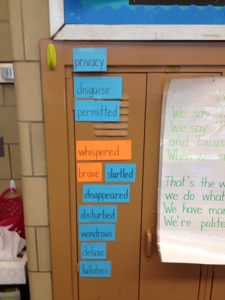
It is far too hot and humid for October. I sure hope it cools off before our apple unit next week! I meant to take pictures of our rock explorations from last week, but time flew by without a single picture. Instead of randomly taking pictures of things, I decided to add some structure to my fall blog posts and start a blog series called,  "Lesson Plan Peek." Over the next few weeks, I will pick different parts of my lesson plan and explain how that piece of our day works. For this first post, I have decided to talk about vocabulary instruction. Here is a quick picture of our "Wonderful Words" display. As you can see, this is only a temporary display spot...we are quickly running out of space for all our words. 


Our district is focusing on vocabulary instruction this year. Research shows that knowing a variety of words is an important part of language development and comprehension. If you need a refresher on vocabulary instruction, Bringing Words to Life by Isabel Beck, Margaret McKeown, and Linda Kucan is a quick and easy read! As an early childhood teacher I know how important vocabulary is; however, it is easy to overlook this part of instruction if not well planned before hand. So this year my team added a vocabulary column to our lesson plan template, and voila! My vocabulary instruction has increased quite a bit. This is how we weave vocabulary into our shared reading time...it is quick and easy and really requires little prep considering the bang you get for your buck. Here's what it looks like... 

1. Before Reading: Pick out 2-3 words that are rich vocabulary words. Think about those Tier 2  words when picking. In Bringing Words to Life, the authors suggest the best time to engage in vocabulary work is after the story. So this part needs to be very quick! Don't spend a lot of time talking about the words before the story. Write them on a sentence strip or index card. Show the students the words quickly, reading them out loud and then telling them that these are some words they will see in today's story.

2. During Reading: When you get to one of the words that you chose for today's vocabulary lesson, read the sentence. "Lily never left the house without a disguise." Explain disguise QUICKLY..." A disguise is a costume." Then read the sentence again... " Lily never left the house without a disguise." Continue this quick process for each word that you have chosen for today's lesson. Again, since you are reading aloud, you can provide the meaning right then and there to aid in comprehension, but then move on.

3. After Reading: This is where the bulk of the vocabulary instruction happens for K-2. Now that you have read the story, students can use the context of the story to help them understand new words (Beck, McKeown, Kucan, 2002). After reading, we do a lot of TTYP or Turn To Your Partner and discuss. For the word disguise, I may have them tell about a time when they wore a disguise...and encourage the use of the target word disguise. For the word whisper, I may have them say the word whisper if I give a scenario where whispering happens (i.e. in the library, on a roller coaster etc.). 

The authors of Bringing Words to Life say this about vocabulary instruction, "The final decision about which words to teach may not be as important as thoughtful consideration about why to teach certain words and not others." We must be reflective and thoughtful while planning instruction, especially for vocabulary!